The following article is presented with permission from Dow Jones
CSI, Veteran Editing System, Is Retired After 22-Year Run
By Jim Pensiero
Scan the CSI Timeline.
NEW YORK--It was big. It was green. It first appeared in Dallas in 1978. It migrated to New York in 1983, where it scared the star.barneydash out of Wall Street Journal editors on 22 Cortlandt Street.
 "It" was CSI, the mainframe-based,
green-screen editing system that brought the Journal and its refractory No.2-pencil-wielding editors into the digital
age. The transition from manual typewriters to a VDT often wasn't pretty, as the staff struggled with the zen of
logging on, mastered its arcane style coding (*2242bi., *1243sr., *zero., hike!) and endured panic-inducing messages
like CPU CHNG. That one was enough to make even the most grizzled editors log off and head for the can. Today,
22 years later, CSI at Dow Jones is being laid to rest.
"It" was CSI, the mainframe-based,
green-screen editing system that brought the Journal and its refractory No.2-pencil-wielding editors into the digital
age. The transition from manual typewriters to a VDT often wasn't pretty, as the staff struggled with the zen of
logging on, mastered its arcane style coding (*2242bi., *1243sr., *zero., hike!) and endured panic-inducing messages
like CPU CHNG. That one was enough to make even the most grizzled editors log off and head for the can. Today,
22 years later, CSI at Dow Jones is being laid to rest.
It is difficult to get too sentimental about a computer editing system, especially one as long in the tooth as CSI. Near the end of its days in the World Financial Center newsroom, more than 15 years after it arrived new and shiny, CSI could be a cranky geezer. And in an age where Intel doubles the processing power of its chips every year or so, the CSI technology from the mid-1970s was a veritable Methuselah of systems. But once customized, installed and tuned, CSI was first-rate at what it did.
"Programmers today, with a gigahertz processor and hundreds of megabytes sitting on their desk, would be astounded if they could see how a PDP11 computer with minuscule memory and very slow processor was able to satisfy 80 impatient journalists at deadline,'' said Robert A. Rosenthal, one of CSI's pioneer developers who currently is a technology consultant for the Journal.
Even as it aged, for the editors at the Journal and Barron's, CSI had one saving grace: it worked. It could be sluggish, repeatedly sending "WORKING" messages when every copy editor in the joint simultaneously hit the H&J button at deadline. And there were some nasty crashes over the years that had staffers riding the WFC elevators in search of a functioning CPU like sailors moving to the other side of a sinking ship. Despite the occasional problems, CSI never stayed down for the count. The Journal came out every night, riding the glowing green galleys of type--multiple takes, nuledes, heds, subgrafs, inserts and roche boxes--to the composing rooms where the pages were built.
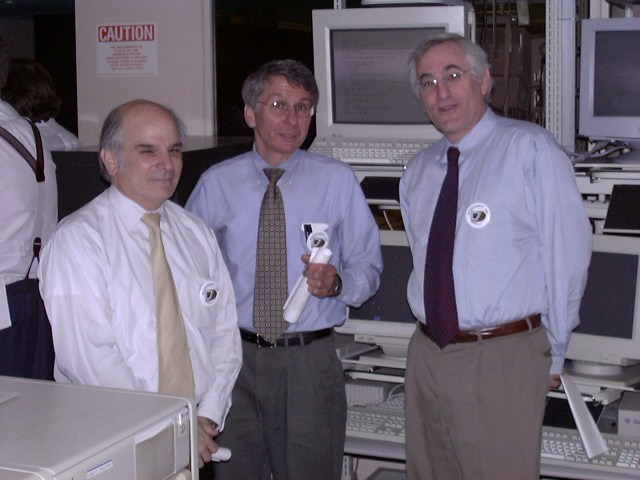
Barron's Managing Editor Rich Rescigno, WSJ technical guru Rich Schuster and consultant Robert A. Rosenthal in Dow Jones' computer room for shut down ceremony
CSI was finally ousted when the Unisys Hermes pagination system was installed at the Journal and Barron's in 2000 and 2001. But the writing was on the wall for years. In the spring of 1990, less than five years after a full-scale CSI editing system was installed at the Journal's new newsroom on 200 Liberty Street (the 1983 version on Cortlandt Street was a mere pilot project), work began on functional specifications for a replacement for CSI. Those specifications eventually morphed into the GNMS project.
The old green-screen also was being nipped on its flanks by Quark Xpress and a PC-based editing system devised for Bob Bartley's Editorial staff. And when a Quark-based QPS system was installed in 1997 to produce Weekend Journal, editors got a taste of what a modern desktop publishing environment was like--and they quickly embraced it. While editing and headline writing became second nature on CSI with some experience, you could never build pages on it.
Still, despite these shortcomings, CSI held on. When GNMS was abandoned in early 1999, CSI got a Y2K tune up and soldiered on as Hermes was installed and went live in February 2000. The last WSJ editing on CSI was done in September 2000, while Barron's and International's Overseas Copy Desk finally logged off for the last time in April 2001.
It was a great run.
TIMELINE FOR CSI AT DOW JONES
1966 - 1975
CSI was founded and developed its first- and second-generation products. These were typesetting and back-end newspaper systems sold into commercial typography shops and small newspapers. They were based on DEC PDP8 computers, began as paper-tape processors and by the mid- seventies supported a small number of VDTs with on-line disk storage.1975 - 1979
CSI developed a new product based on the DEC PDP11/70 computer and the RSX11M operating system. This is the front-end newspaper system used by Dow Jones. Bob Rosenthal, who currently works for the WSJ on a consulting basis, was the primary architect of this system; he designed the editorial application, the database, the software architecture, and wrote a large quantity of the code.By 1979 the product was a dual processor, fault-tolerant, fully redundant system that was considered by many as the best in the industry.
1978 - 1981
Dow Jones ordered and installed its first and second systems. These were identical dual processor, back-end systems for Chicopee and Dallas. The users were primarily composing-room personnel, who would mark-up and typeset copy received by IMOS and fax from the editorial offices.Each of the two sites was a backup for the other. The complete dynamic database was dual-recorded across dedicated communication lines, actually maintaining four copies of everything, two in each site. Remote composing shops for handling regional editions were installed in Naperville, Palo Alto and Orlando; each consisting of VDTs and typesetters connected remotely to either the Chicopee or Dallas system.
Special considerations were a classified-ad system, modified to handle the Dow Jones Digest of Earnings, an interface to the Dow Jones type distribution back-end, numerous special on-line input formats and multiple typesetting programs to accommodate their various typesetters (and typesetters emulating other typesetters).
1980 - 1982
The CSI product was expanded to allow up to four processors, which could support a larger quantity of VDTs. This expansion made use of multiported disk controllers that allowed each PDP11 computer to access every disk drive. An enhanced editorial application was renamed the News Management System although most of the application effort at that time was put into a new advertising system.1983
A small "pilot" editorial system was placed into Dow Jones's old news offices in New York City. A small number of journalists used this to edit copy that was received through IMOS and then sent back through IMOS to Chicopee for typesetting. Remote VDTs were placed in the Washington, Philadelphia and Los Angeles bureaus.1983 - 1984
In a critical and highly visible situation, CSI installed a news-processing system in Brussels and a remote composing-room operation in the Netherlands for the introduction of the European Wall Street Journal.1985 - 1987
This period was marked by the relocation of the editorial departments of The Wall Street Journal to their new offices at the World Financial Center. Three CSI News Mannagement Systems were ordered and installed, and the earlier pilot system was shipped to Hong Kong for use on the Asian Journal.With these installations the core Dow Jones editors began use of CSI for the management and production of their publications. Some special software was written and many procedural solutions to Dow Jones requirements were worked out.
1988
Dow purchased the Typenodes system from Crosfield, which had purchased CSI in 1986. Typenodes involves placing stripped-down CSI systems at all of Dow's composing sites, and then using CSI internal coding structure as a typesetter independent method of communicating text. This was to be combined with several new typesetter drivers, thus allowing users to make typography decisions without regard for the particular class of typesetter in each location.1994
Editorial Department stops using CSI, utilizing a PC-based system that delivered files to the Orlando composing room. Pages were built in Quark.CSI begins feeding Mac-based makeup systems in the composing rooms, gradually eliminating pasteup pages.
2000
Hermes installed at WSJ. CSI use ends.2001
Overseas Copy Desk stops using CSI, editing instead on a PC-based system. Barron's switches to Hermes.