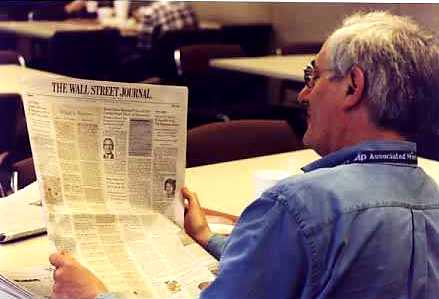
During the past 35 years Robert A. Rosenthal has witnessed the complete
revolution of his industry.
The newsroom environment, in which Rosenthal started his career, doesn't exist today. Gone are the click-clack
of typewriters and teletype wire service machines. Today's reporters and editors rely on computers and desktop
publishing to do their work.
Rosenthal, the founder of RAR & Associates, a Stamford-based consultancy with expertise in computerized typesetting,
typography and newspaper production, has seen remarkable changes as he spent his career working with newspapers
all over the world.
Rosenthal's most recent project, and perhaps his most visible, is his work on the redesign of the Wall Street Journal.
The Wall Street Journal debuted its new look on April 9. The design, which includes a new layout and the use of
color, was the first major overhaul of the Journal's front page in more than 60 years.
Rosenthal compares the Wall Street Journal project to crafting a new car. Designers and engineers work together
-- designers to create the car's look and the engineers to make it possible to reproduce the car repeatedly and
efficiently.
In the case of the Wall Street Journal, designers spent about 15 months creating the new Journal look. When finished
they handed over a single prototype to Rosenthal, he said.
Like an automotive engineer, Rosenthal was the software engineer who took the prototype and made it possible for
the newspaper's editors and layout artists to reproduce it every day.
It's been a frantic few months, said Rosenthal, who got the prototype in early January and had three months to
implement the design in the newspaper's production system. Rosenthal had to work backwards, or "reverse engineer"
the design so he could build it in the Wall Street Journal's pagination system, called Unisys Hermes.
Doing what Rosenthal did for the Wall Street Journal can be complicated, said Alan Jacobson president of Brass
Tacks Design, a Norfolk, Va., firm that provides design and technical support to newspapers worldwide.
What large papers such as the Journal are looking for is fidelity, or a perfect match, between the prototype and
the printed product, said Jacobson, who has worked on redesign projects for The Hartford Courant and The St. Louis
Post-Dispatch.
What is difficult is that the prototype design is built on one platform and the technician has to make it work
on another platform. And it's the level of fidelity that determines the complexity of the job, he said.
Rosenthal, a 25-year Stamford resident, has spent his career working with various newspaper and book publishers,
much of the time for the now-defunct Composition Systems Inc., an Elmsford, N.Y., company known for its newspaper
front-end system.
"I've been involved in several huge revolutions that changed the print industry dramatically," Rosenthal
said.
One of the first major moves was from hot metal typesetting with molten lead to the use of photographic techniques
called cold type, he said.
When Rosenthal began working for CSI, the newspaper industry was going through another revolution where proprietary
computers allowed newsroom staff to enter and format text. Editors and reporters were able to control text from
beginning to end in the newsroom instead of sending typewritten pages off to a back shop, he said.
It was during this time that Rosenthal helped created the CSI newspaper front-end system -- a mainframe-based editing
system. He was the architect and lead programmer of the system that was regarded as one of the three top news systems
in the business.
CSI was installed in about 200 newspapers around the world, including The Wall Street Journal, The Portland Oregonian,
The Johannesburg Star, and The London Mirror.
The Advocate and Greenwich Time used the CSI system for 16 years, and Rosenthal was present in 1997 when the papers
shut CSI down to switch to a desktop publishing system. He was also present in April 2001 when the Wall Street
Journal turned off its CSI system after 22 years.
Papers began to phase out systems like CSI when desktop computers and desktop publishing became ubiquitous in newsrooms,
he said.
Despite all the changes Rosenthal has experienced, one of the things that doesn't change is his pleasure in seeing
the final product daily.
"One of the joys of doing what I do is at 7:30 every morning I walk down my driveway and I pick up my newspaper
and see the results of my labor," Rosenthal said.
